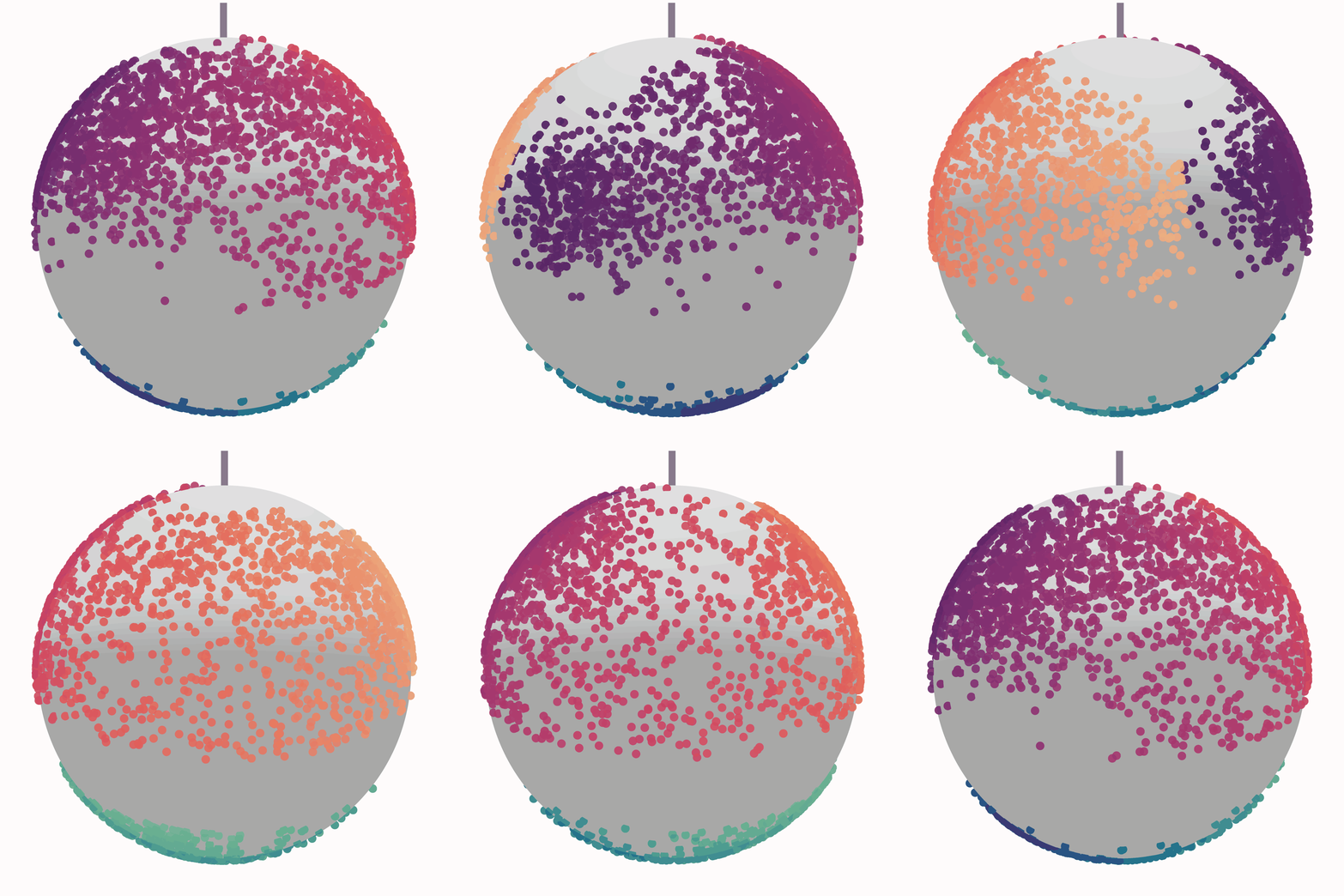
Seurat (R) tutorial
How to run Ouroboros on a Seurat (R) object
Ouroboros is a python package, so running it on a Seurat object requires saving your raw counts as a CSV file and running the command-line implementation of Ouroboros on the saved CSV. The ouroboros output can then be loaded into back into R.
Dependencies:
- Seurat
- SeuratObject
- Matrix
- Zellconverter
- SingleCellExperiment
suppressPackageStartupMessages({
  library(Seurat)
  library(SeuratObject)
  library(Matrix)
  library(zellkonverter)
  library(SingleCellExperiment)
  library(SeuratData)
})
We'll demonstrate Ouroboros using pbmc3k, a standard dataset of 2,700 PBMCs (~13,700 genes) that ships as raw counts. We subset it to 100 cells to remove computational time and written object size.
InstallData("pbmc3k")
data("pbmc3k")

pbmc3k   # ~2700 cells x ~13714 genes, raw counts in the RNA assay
Installing package into ‘/projects/pangen/analysis/hmac/applications/miniconda3/lib/R/library’
(as ‘lib’ is unspecified)
set.seed(330)
cells <- colnames(GetAssayData(pbmc3k, assay = "RNA", layer = "counts"))
pbmc100 <- pbmc3k[, sample(cells, 100)]
Next write the raw counts as a Scanpy h5ad object to run ouroboros on. p.s. this tends to take a long time (~ 15 minutes)
# Seurat -> SingleCellExperiment
sce <- as.SingleCellExperiment(pbmc100)

# confirm a raw-counts assay is present
assayNames(sce)          # expect "counts" (and usually "logcounts")

# write .h5ad with RAW counts in .X
writeH5AD(sce, "R_example_output/pbmc_small.h5ad", X_name = "counts")
- 'counts'
- 'logcounts'
There is still some formatting of that h5ad that needs to be done so Ouroboros will recognize it. Run this in a terminal (replace the h5ad path with your own):
conda activate ouroboros_env

# go to your output dir
cd R_example_output
python - <<'PY'
import h5py, numpy as np, anndata as ad
path = "pbmc_small.h5ad"
vlen = h5py.special_dtype(vlen=str)
with h5py.File(path, "r+") as f:
    if "layers/raw_counts" not in f:
        f.copy("X", "layers/raw_counts")

    # strip modern 'dict' tags (already done, but harmless to repeat)
    def fix_dict(name, obj):
        if isinstance(obj, h5py.Group):
            et = obj.attrs.get("encoding-type")
            et = et.decode() if isinstance(et, (bytes, bytearray)) else et
            if et == "dict":
                del obj.attrs["encoding-type"]; obj.attrs.pop("encoding-version", None)
    f.visititems(fix_dict)

    # flatten obs/var to index-only: drop categorical/group columns the old reader can't parse
    for key in ("obs", "var"):
        if key not in f: continue
        g = f[key]
        idx = g.attrs.get("_index", "_index")
        idx = idx.decode() if isinstance(idx, (bytes, bytearray)) else idx
        for col in list(g.keys()):
            if col != idx:
                del g[col]
        g.attrs.create("column-order", np.array([], dtype=vlen))
PY
Double check it worked with this:
python - <<'PY'
import anndata as ad
a = ad.read_h5ad("pbmc_small.h5ad")
print("OK:", a.shape, "| genes:", list(a.var_names[:3]), "| raw_counts:", "raw_counts" in a.layers)
PY
Then run Ouroboros on test object on command line
Call:
ouroboros \
    --data pbmc_small.h5ad \
    --data_type h5ad \
    --outdir .
Read Ouroboros output into Seurat object
emb <- read.csv(
  "R_example_output/ouroboros_embeddings_pseudotimes.csv",
  row.names = 1,          # first column is the cell_id index pandas wrote
  check.names = FALSE     # keep column names like dim1/dim3 exactly as-is
)

# sanity check: do the IDs line up with the Seurat object?
head(rownames(emb))
head(colnames(pbmc100))
mean(rownames(emb) %in% colnames(pbmc100))   # want this to be 1

# add all Ouroboros columns to the cell metadata
pbmc100 <- AddMetaData(pbmc100, metadata = emb)

head(pbmc100@meta.data)
- 'AAACCGTGCTTCCG'
- 'AAAGAGACGCGAGA'
- 'AAGATTACCCGTTC'
- 'AAGCAAGAGGTGTT'
- 'AAGTTCCTCATTCT'
- 'AATGTTGATCTACT'
- 'AAACCGTGCTTCCG'
- 'AAAGAGACGCGAGA'
- 'AAGATTACCCGTTC'
- 'AAGCAAGAGGTGTT'
- 'AAGTTCCTCATTCT'
- 'AATGTTGATCTACT'
| orig.ident | nCount_RNA | nFeature_RNA | seurat_annotations | RNA_snn_res.0.5 | seurat_clusters | dim1 | dim2 | dim3 | KNN_phase | cell_cycle_pseudotime | south | dormancy_depth | G0_classification | |
|---|---|---|---|---|---|---|---|---|---|---|---|---|---|---|
| <fct> | <dbl> | <int> | <fct> | <fct> | <fct> | <dbl> | <dbl> | <dbl> | <chr> | <dbl> | <chr> | <dbl> | <chr> | |
| AAACCGTGCTTCCG | pbmc3k | 2639 | 960 | CD14+ Mono | 1 | 1 | -0.2796167 | 0.9579706 | -0.06408316 | G0 | NA | True | -0.5078842 | quiescence |
| AAAGAGACGCGAGA | pbmc3k | 3033 | 1058 | CD14+ Mono | 1 | 1 | -0.7858221 | 0.5954063 | 0.16725660 | G0 | NA | True | -0.8482282 | senescence |
| AAGATTACCCGTTC | pbmc3k | 2762 | 928 | CD14+ Mono | 1 | 1 | -0.6899688 | 0.5372884 | 0.48504025 | G0 | NA | True | -0.8712022 | senescence |
| AAGCAAGAGGTGTT | pbmc3k | 1684 | 857 | NK | 0 | 0 | -0.5400499 | -0.5703587 | 0.61889990 | G2M | NA | True | -0.4522001 | quiescence |
| AAGTTCCTCATTCT | pbmc3k | 2334 | 862 | FCGR3A+ Mono | 1 | 1 | -0.0417582 | 0.4772747 | 0.87776140 | G0 | NA | True | -0.4849494 | quiescence |
| AATGTTGATCTACT | pbmc3k | 2672 | 960 | Memory CD4 T | 0 | 0 | -0.6850837 | 0.7279406 | -0.02761939 | G0 | NA | True | -0.7152675 | senescence |
pbmc100 <- NormalizeData(pbmc100)
pbmc100 <- FindVariableFeatures(pbmc100)
pbmc100 <- ScaleData(pbmc100)
pbmc100 <- RunPCA(pbmc100, npcs = 30)
pbmc100 <- RunUMAP(pbmc100, dims = 1:20, n.neighbors = 15)

DimPlot(pbmc100, reduction = "umap")
Warning message in simpleLoess(y, x, w, span, degree = degree, parametric = parametric, :
“pseudoinverse used at -2.019”
Warning message in simpleLoess(y, x, w, span, degree = degree, parametric = parametric, :
“neighborhood radius 0.32006”
Warning message in simpleLoess(y, x, w, span, degree = degree, parametric = parametric, :
“reciprocal condition number  0”
Warning message in simpleLoess(y, x, w, span, degree = degree, parametric = parametric, :
“There are other near singularities as well. 0.031008”
Centering and scaling data matrix

PC_ 1
Positive:  CST3, AIF1, LST1, FCER1G, TYROBP, CFD, FTL, NPC2, FTH1, S100A11
	   LGALS1, FCN1, LYZ, CTSS, PSAP, S100A9, SERPINA1, CD68, RP11-290F20.3, SAT1
	   BRI3, TYMP, SPI1, MNDA, COTL1, IFITM3, IFI30, MS4A7, FGR, OAZ1
Negative:  MALAT1, RPS6, RPL13, LTB, ISG20, CD3E, CD7, CXCR4, RPLP0, CTSW
	   LYAR, FKBP11, CCL5, CCR7, NKG7, GZMA, UBXN4, NOSIP, RARRES3, TRABD2A
	   TRAT1, DENND2D, RPL10, S1PR4, HSPE1, BBC3, RPS14, PBXIP1, AQP3, TCF7
PC_ 2
Positive:  FCGR3A, UBLCP1, CST7, CETP, B2M, HAT1, EMR2, FGFBP2, GZMA, ABI3
	   C2orf42, ZNF593, HSPA6, HIST3H2A, HS6ST1, ZBTB17, C1orf51, EXOC6B, PARP6, PPP1R12B
	   NLRC4, CNNM3, RHOC, NKG7, GZMH, LILRA2, WRAP73, CTSW, GZMB, IFIT1
Negative:  S100A8, LGALS2, CD14, GPX1, MS4A6A, CSF3R, S100A9, LYZ, FOLR3, S100A12
	   RPL13, BNIP3L, FCN1, NCF1, CD79A, FCGR1A, HLA-DRB1, FES, PLBD1, GRN
	   RNASE6, HLA-DRA, RBP7, AP1S2, IER3, BANK1, HLA-DQB1, SRGAP2, MS4A1, FPR1
PC_ 3
Positive:  GZMA, FGFBP2, NKG7, GZMB, FCRL6, CST7, S100A9, CTSW, PRF1, GNLY
	   S100A8, XCL2, SPON2, GZMH, MATK, BPGM, S1PR5, TYROBP, CCL4, MS4A6A
	   CCL5, APMAP, PDIA4, PTGDR, CD14, AGTRAP, LGALS2, B2M, S100A4, KLRD1
Negative:  HLA-DQA1, HLA-DQB1, CD79A, EAF2, LINC00926, HLA-DQA2, MS4A1, CD79B, TCL1A, HLA-DPA1
	   IGLL5, POU2F2, CD74, FCER2, CD180, CD72, HLA-DPB1, CD1C, HLA-DRA, HLA-DRB1
	   CCDC50, TAMM41, HLA-DOB, P2RX5, TSPAN13, BLNK, ZNF766, PPP1R14A, PKIG, NOTCH2
PC_ 4
Positive:  FGFBP2, FCRL6, MATK, GZMB, MARCKSL1, GZMA, BPGM, CST7, HLA-DQA1, GNLY
	   NKG7, HLA-DQB1, SPON2, HLA-DQA2, GZMH, TTC14, S1PR5, CD79B, EAF2, CD79A
	   PRF1, LAT2, LINC00926, IGLL5, HLA-DPA1, HLA-DOB, HLA-DPB1, CD74, DOCK5, TBC1D17
Negative:  TCF7, SAMD9, COX4I1, MTIF3, HSPB1, RGCC, JUNB, HPCAL1, KLHL22, MAGED2
	   CD3E, TRABD2A, SPATS2L, SSBP1, VIM, TRAT1, SMAP1, TNFRSF4, HIST3H2A, PARP6
	   HS6ST1, CNNM3, EXOC6B, PPP1R12B, C1orf51, ZBTB17, ZNF593, C2orf42, NLRC4, HSPA6
PC_ 5
Positive:  ZNF503, DHRS9, ZNF652, CLCN6, PHGDH, INTS3, MGAT5, AC079305.10, FCER1A, AGBL5
	   CCDC88A, ENHO, TMCC2, MTIF2, CD1C, MGST2, GPX3, DHRS1, LOH12CR2, ROGDI
	   CCT5, CYSTM1, TFPT, CCDC50, PHACTR1, LARP1B, HDAC2, SRM, COA1, NRGN
Negative:  MS4A1, CD79B, P2RY10, TCL1A, SWAP70, PKIG, CD79A, TCOF1, EMR2, POLD4
	   CD72, SCPEP1, HLA-DOB, KIAA0125, NAT9, SIGLEC10, DUSP6, PILRA, LINC00926, MT-ND2
	   SEC62, UBE2E1, FCER2, AAMP, APH1B, CTD-2006K23.1, TSPAN13, PDLIM1, FCGR3A, LINC01013

Warning message:
“The default method for RunUMAP has changed from calling Python UMAP via reticulate to the R-native UWOT using the cosine metric
To use Python UMAP via reticulate, set umap.method to 'umap-learn' and metric to 'correlation'
This message will be shown once per session”
18:25:41 UMAP embedding parameters a = 0.9922 b = 1.112

18:25:41 Read 100 rows and found 20 numeric columns

18:25:41 Using Annoy for neighbor search, n_neighbors = 15

18:25:41 Building Annoy index with metric = cosine, n_trees = 50

0%   10   20   30   40   50   60   70   80   90   100%

[----|----|----|----|----|----|----|----|----|----|

*
*
*
*
*
*
*
*
*
*
*
*
*
*
*
*
*
*
*
*
*
*
*
*
*
*
*
*
*
*
*
*
*
*
*
*
*
*
*
*
*
*
*
*
*
*
*
*
*
*
|

18:25:41 Writing NN index file to temp file /tmp/RtmppLebTQ/file5728e428c0b74

18:25:41 Searching Annoy index using 1 thread, search_k = 1500

18:25:41 Annoy recall = 100%

18:25:43 Commencing smooth kNN distance calibration using 1 thread
 with target n_neighbors = 15

18:25:45 Initializing from normalized Laplacian + noise (using RSpectra)

18:25:45 Commencing optimization for 500 epochs, with 1866 positive edges

18:25:45 Using rng type: pcg

18:25:47 Optimization finished

# Can colour UMAPs by Ouroboros variables
FeaturePlot(pbmc100, features = "cell_cycle_pseudotime")